Some works look like paintings and, up close, turn out to be objects: heavy, precise, with a surface that changes with the light. That is what Gerold Miller proposes in Superficie y presencia (Surface and Presence), his first solo exhibition in Latin America, on the ground floor of MACBA in Buenos Aires. We spoke with the German artist about his method, his materials and what he expects from the city.
A sculptor between painting and space
Miller describes himself plainly: a minimalist conceptual artist and sculptor. His interest, he says, is not personal expression or a distinctive style, but "developing an idea and translating it into material as precisely as possible." His work lies between painting and sculpture, but what matters to him is not that in-between space itself, but the relationships that emerge from it: "When I define one area, another becomes visible. When I leave a surface untouched, its boundaries become more important."
Metal, lacquer and a surface without gestures
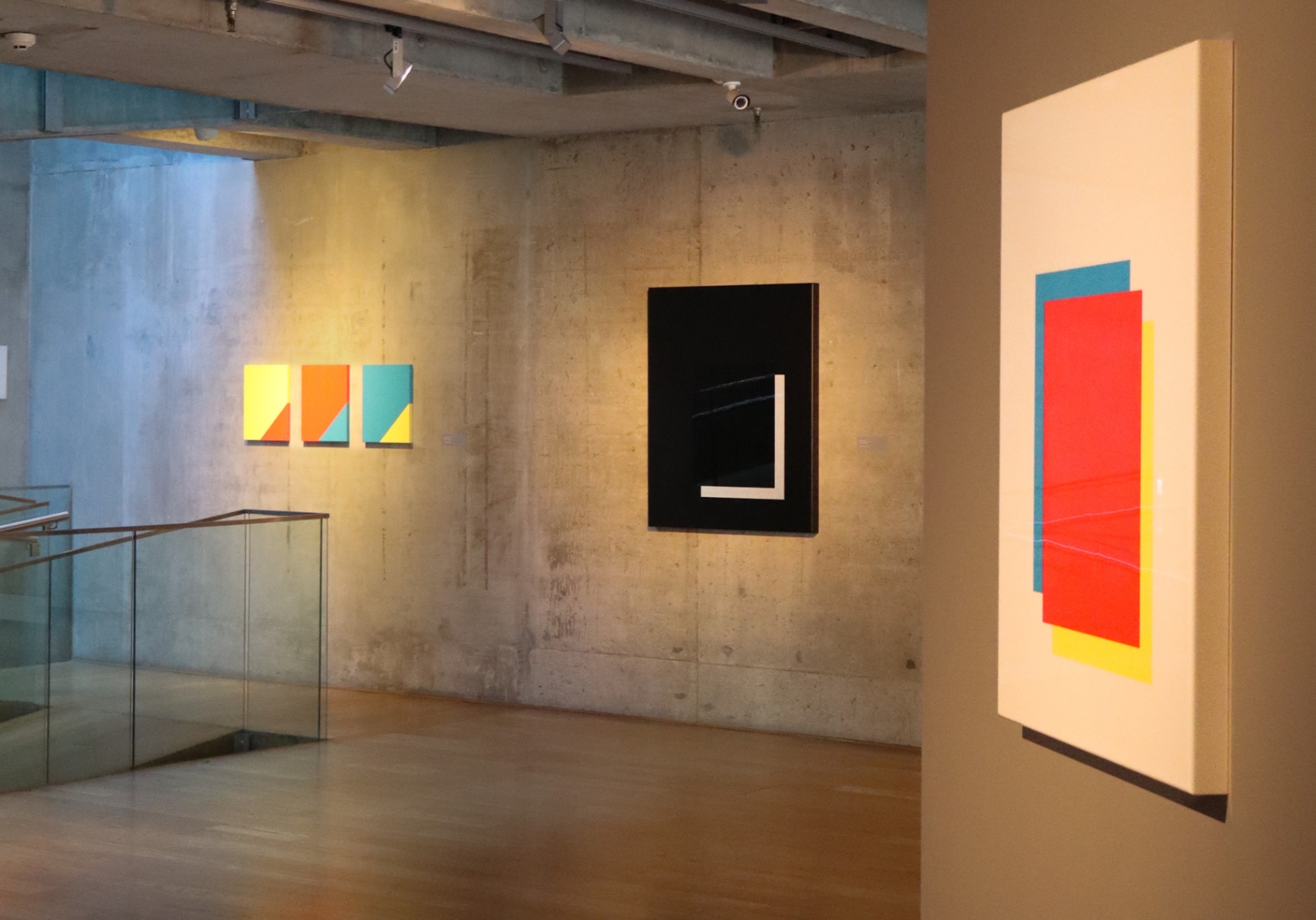
In set and Verstärker, the series on view at MACBA, everything is carefully decided. Miller chooses metal for its hardness and precision, and industrially applied lacquer because it lets him apply color evenly, without visible brushstrokes. That way he avoids any expressive gesture that could distract from the idea. The contrast between matte and glossy areas affects how the works are perceived and highlights their three-dimensional quality: they may look like flat images, but they have real depth.
He is clear about one thing: he has never worked with canvas or a paintbrush. "I am not a painter, and painting is not a medium that interests me," he says. Choosing these materials, he adds, is not a way of distancing himself from painting but of finding the best way to realize his ideas. He also values weight: his works are heavy, and that is an important part of the work, not just a technical characteristic.
A process that happens in his head
Most of the creative process, he explains, takes place in his head. By the time he starts practical experiments, the ideas are already well developed. He then works with models and small collages; he does not use a computer or traditional drawings. Architectural models of exhibition spaces matter a great deal, since many of his works are made for a specific show and respond to the architecture of the space. Once a model is finished, his studio team takes over production: the designs are digitalized and prepared, the works are made, and finally they are photographed and packed for transport. The key artistic decisions, he insists, are made very early.
Everything open, no required explanation
What does he hope viewers experience? "For me, everything is open; everything is possible. I don't want to tell viewers what to think or how to interpret my work." He acknowledges that the work can be placed in an art-historical context, with references to the art of the 1960s, to specific geographies and to different traditions, and that knowing them can help, but it is not necessary. He likes the idea that people can respond to the work without knowing what they are looking at or what it is supposed to mean.
Buenos Aires, Paternosto and geometry
The exhibition in Argentina means a lot to him. He has shown at art fairs in Miami for many years, and his works have been sold to several countries in Latin America, so a connection already existed. This year his work is also shown at Art Basel Miami Beach and at arteBA, and in December he will have his first solo exhibition in Uruguay, at Galería de las Misiones. He is also interested in the historical links between Argentina, southern Germany and northern Italy, where artists have influenced one another: "In a way, things are coming full circle for me."
He sees clear similarities with Latin American artists who work with geometry, even across generations, mainly in how they think about images and use geometric forms. And he points out a special coincidence: César Paternosto, who is over 90, is exhibiting at MACBA at the same time (La imaginación geométrica). They already knew each other. "He comes from painting, while I come from sculpture, and we belong to different generations. It is interesting to see these similarities and differences come together in the same exhibition context."
What comes next
His studio is preparing a major museum tour across Europe, especially in Germany, Switzerland and Italy, where he has worked the longest and where he lives part of the year (Italy). It is planned to start next spring. He is also starting a collaboration with a gallery in New Zealand and Australia. His practice, he says, will stay centered on how the interplay of material, surface, space and perception can be articulated in new ways. Before that, his next stop is Uruguay.
Superficie y presencia is on view at MACBA (Av. San Juan 328) until November 8.